Chernobyl cleanup remote-controlled robot
Voices from ChernobylThe radio-controlled cleanup machines used on the ruined reactor roof could not reliably withstand the radiation they were sent to confront. Their failures turned a promise of mechanical protection into a demand for human labor: soldiers became the most dependable “robots,” working in the same lethal environment the machines could not master.
Machines Against the Radiation
The machines often failed to carry out commands or did the opposite of what they were instructed to do because the high radiation disrupted their electronics. Their breakdown was not simply a technical inconvenience. The roof had to be cleared of fuel and graphite from the reactor, along with shards of concrete and metal, and the work could not wait for equipment that might malfunction.
The account gives a physical measure of the material the machines encountered: a museum in Kyiv displayed a mold of graphite about the size of a soldier’s cap, which would have weighed 16 kilograms if it were real. The roof debris was not ordinary refuse, and the environment was hostile to both machinery and people.
Soldiers as the Reliable “Robots”
With the radio-controlled machines unreliable, soldiers were called the most dependable robots and dubbed the “green robots” for the color of their uniforms. Some 3,600 soldiers worked on the roof. Across the larger cleanup effort, 210 military units—about 340,000 military personnel—were deployed, but the roof crews faced especially severe exposure.
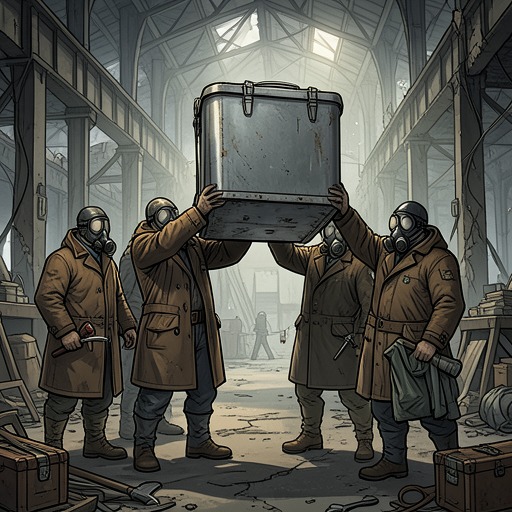
The men gathered the reactor’s fuel and graphite and threw the debris from the roof. A wheelbarrow took only about 20 to 30 seconds to fill, and dumping it took another 30 seconds. The special wheelbarrows weighed 40 kilograms even before they were loaded. Soldiers wore lead vests and masks, but the radiation came from below, where the vests did not protect them; their boots were ordinary, cheap imitation leather. They spent roughly a minute and a half to two minutes on the roof each day, then were discharged with a certificate and an award of 100 rubles.
The contrast is stark: a machine’s exposure disrupted its electronics, while the soldiers’ bodies were sent repeatedly into the same danger. The account recalls them sleeping on the ground in tents and initially spreading straw from stacks near the reactor. The equipment could fail and be set aside; the human substitutes endured the task and then disappeared to distant parts of the country.
The Joke About the Russian Robot
A soldier’s joke made the substitution explicit. In its telling, an American robot and a Japanese robot each lasted five minutes on the roof before breaking down. The Russian robot stayed for two hours, until a loudspeaker summoned Private Ivanov for a cigarette break. The joke turns the supposed superiority of the human worker into a grim measure of enforced endurance: unlike a machine, a soldier could be ordered to remain.
Another soldier described protective gear made by the men themselves, including lead underwear worn over their pants. Before roof duty, some protested that they had already gone and should have been sent home; the commander said only volunteers would go, while warning the others that they would face the military prosecutor. The speaker said he wanted to go and did not protest. In this setting, “reliability” belonged not to a machine engineered for hazardous work but to people bound by military discipline and a sense of duty.
What the Machines Make Visible
The failed machines expose a limit in the cleanup’s technological solution: radiation itself could disable the electronics intended to keep workers away from it. The response was not to remove human beings from the roof, but to place soldiers there instead. Calling them robots captures the grim efficiency of that arrangement while also obscuring the difference between a replaceable device and a person who could be injured, discharged, and left to live with the consequences.
The account remembers the soldiers as young men who were dying years later, and notes that the names of some who took part in the dangerous work survive in museum documents. The machines’ breakdowns thus remain more than a technical detail. They mark the point where the cleanup’s most reliable equipment was human, and where the cost of that reliability fell on the people sent onto the roof.